My travel diary – Part 1
February, 2023
1. On our purpose
Beyond Expeditions, a Singapore adventure tour organizer, has created a series of extreme challenges to raise awareness to important social causes and funds to support endeavors of such causes. The initiative is titled Beyond Limits and its fourth edition set out to conquer Lake Khuvsgul, a large lake in northern Mongolia. The purpose of this trip was to specifically raise awareness to cancer and support the Singapore Cancer Society with funds for their operations.
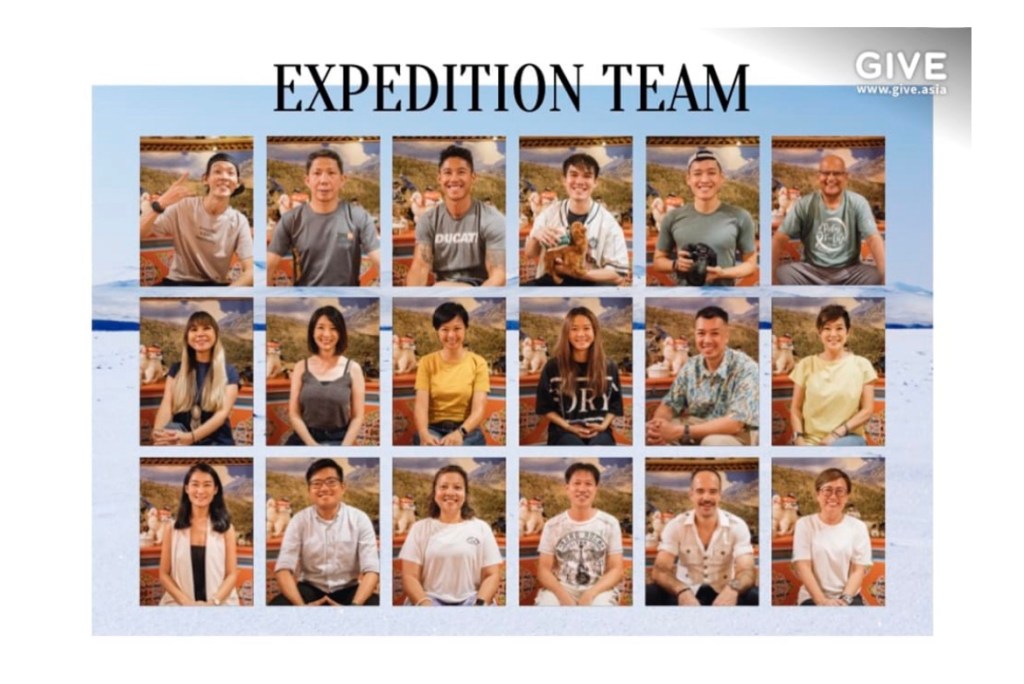
The expedition comprised of trekking and living on the lake for 4 days, facing difficult surface conditions on the ice, as well as sub zero temperatures during the day and night. You can learn more about our expedition and its members by clicking on the below link.
https://give.asia/campaign/beyond-limits-3-on-ice?#/
Flash update: the funds committed by you all to this cause have passed $52K! Thank you for those who already donated. For anyone else who wishes to support, we appreciate your donation in advance!

2. On my purpose
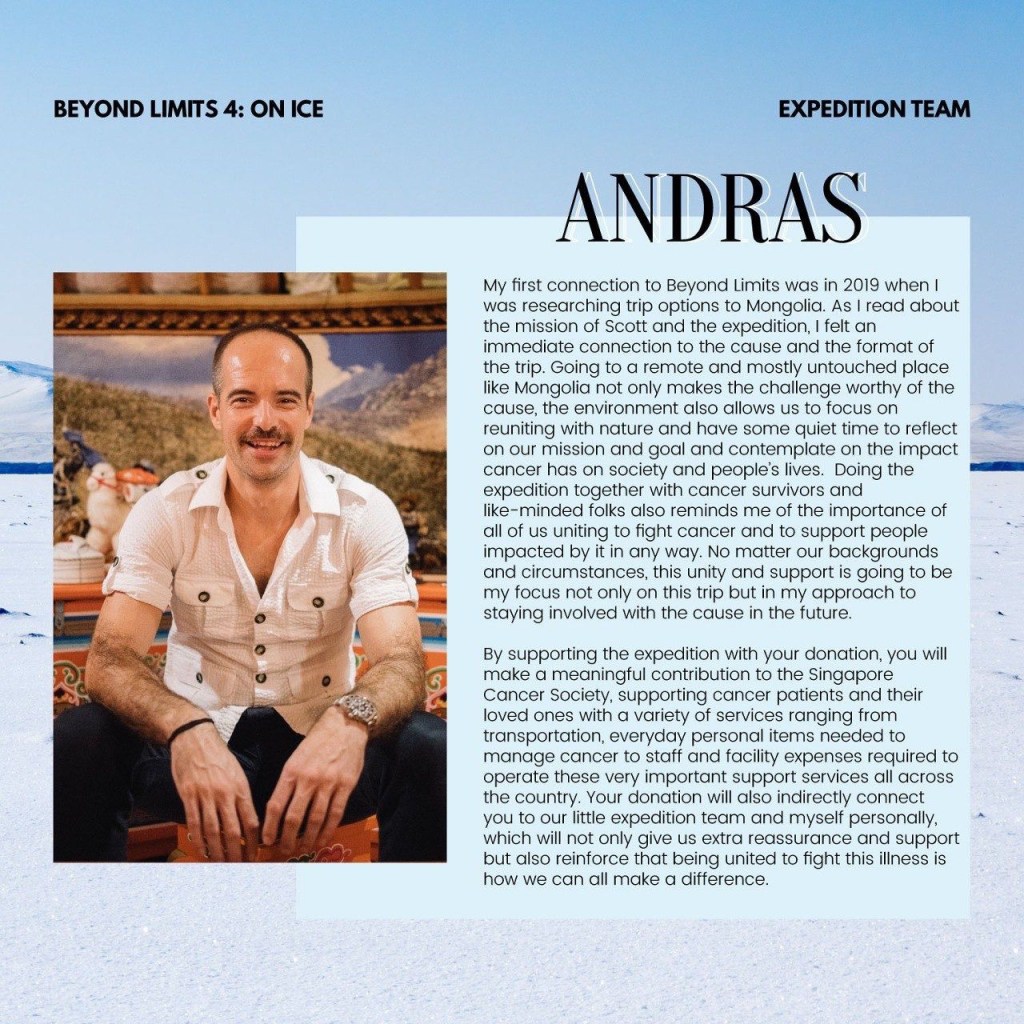
Going to a remote and mostly untouched place like Mongolia not only makes the challenge worthy of the cause, but the environment also allows us to focus on re-uniting with nature and to have some quite time to reflect on our mission and goal and the contemplate the impact cancer has on society and people’s lives.
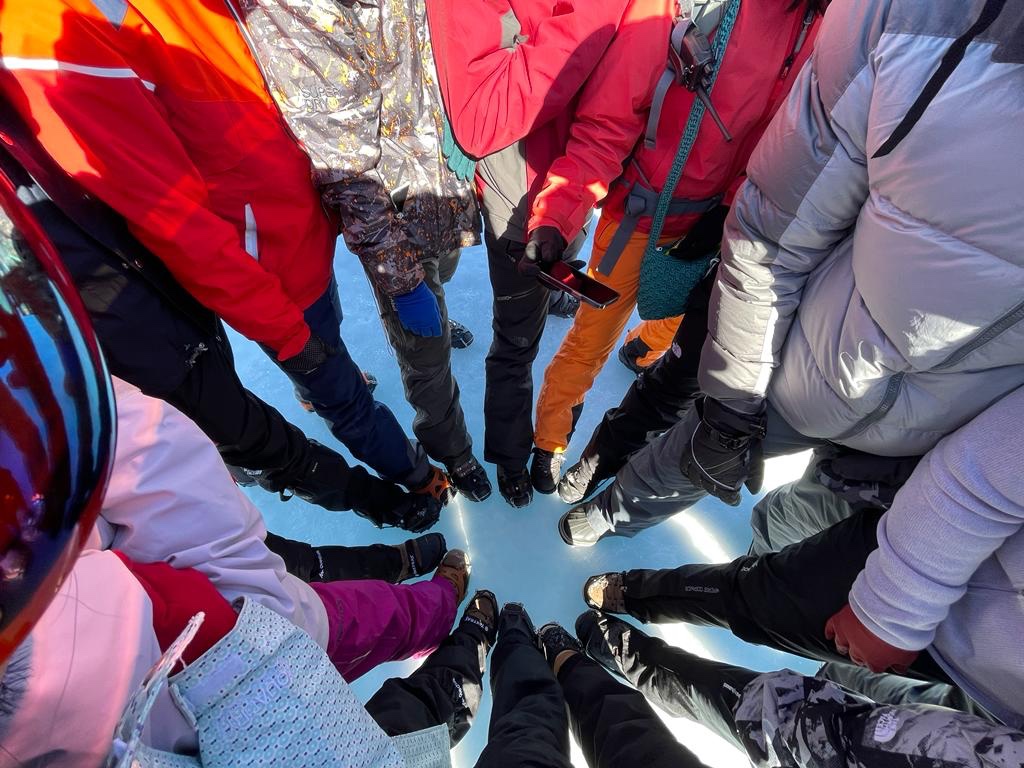
Doing the expedition together with cancer survivors and like-minded folks also reminds me of the importance of all of us uniting to fight cancer and to support people impacted by it in any way. This unity and supporting each other, no matter our backgrounds and circumstances, is going to be my focus not only on this trip but in my approach to staying involved with the cause in the future.
3. On our trip itinerary
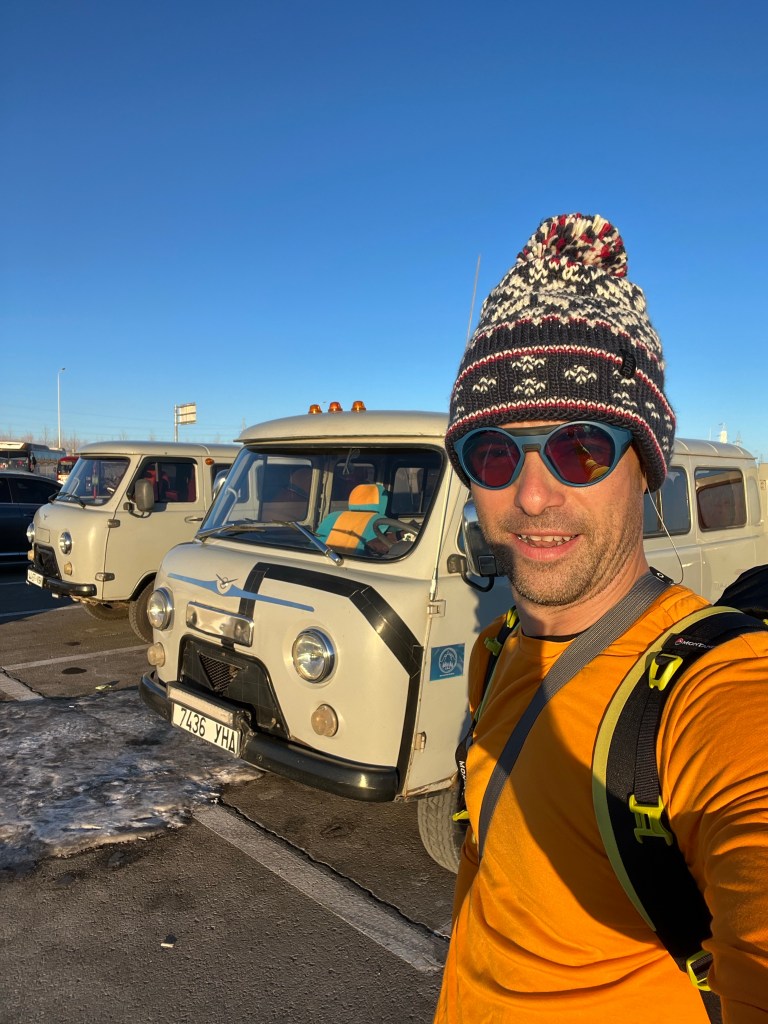
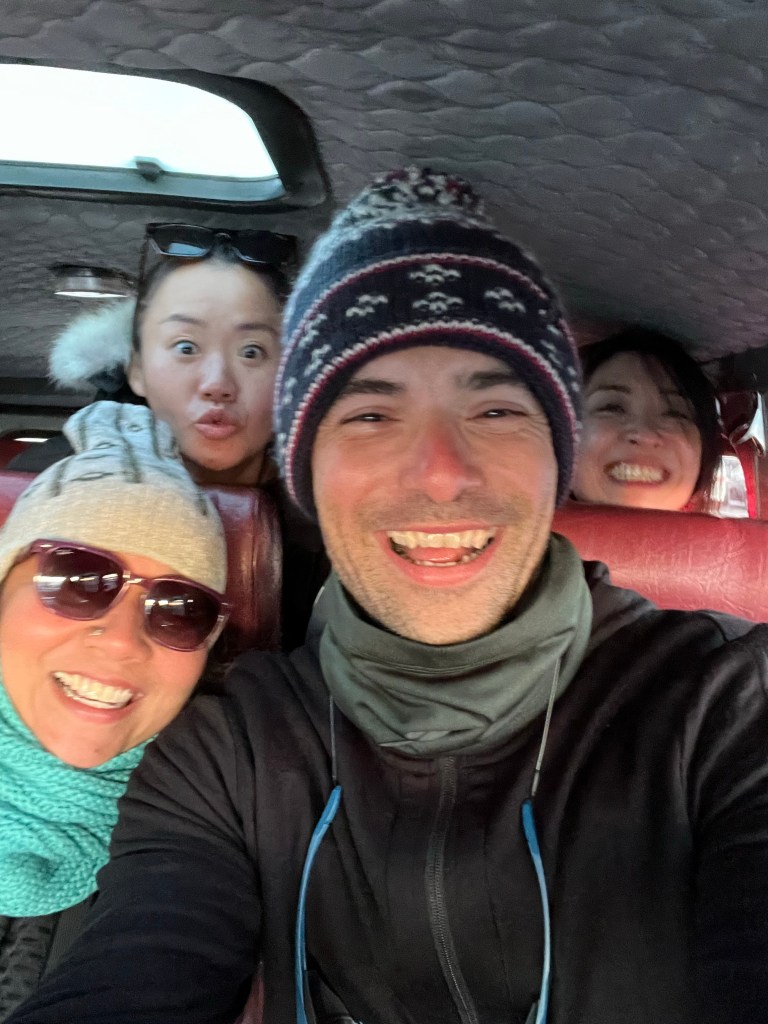
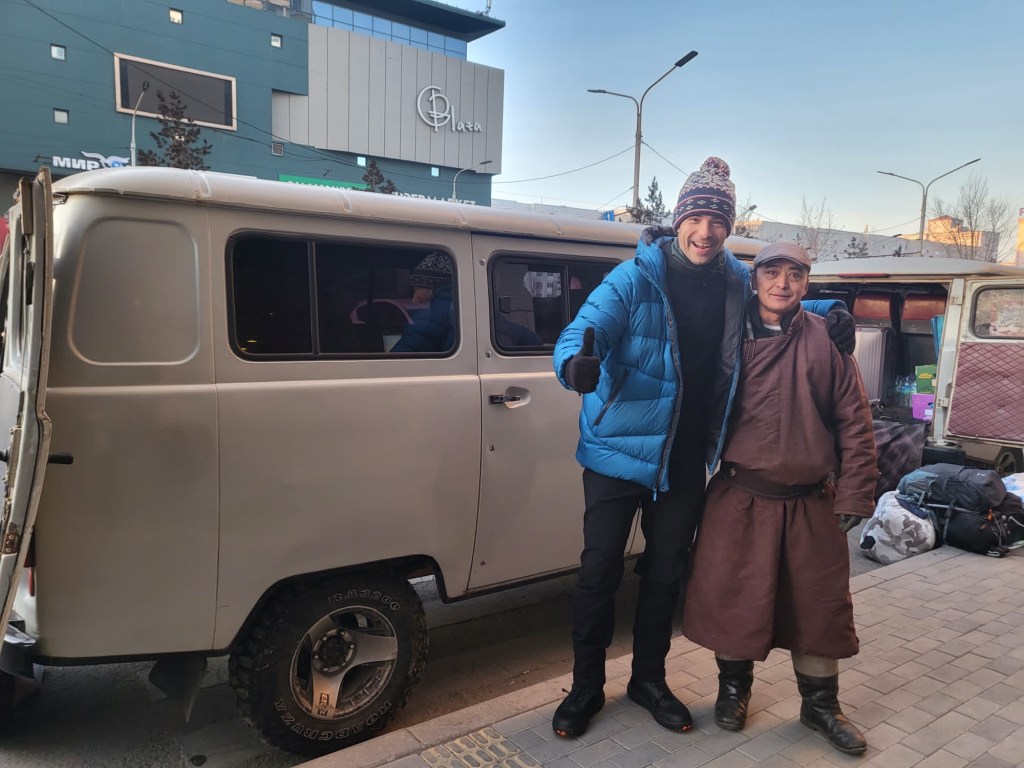
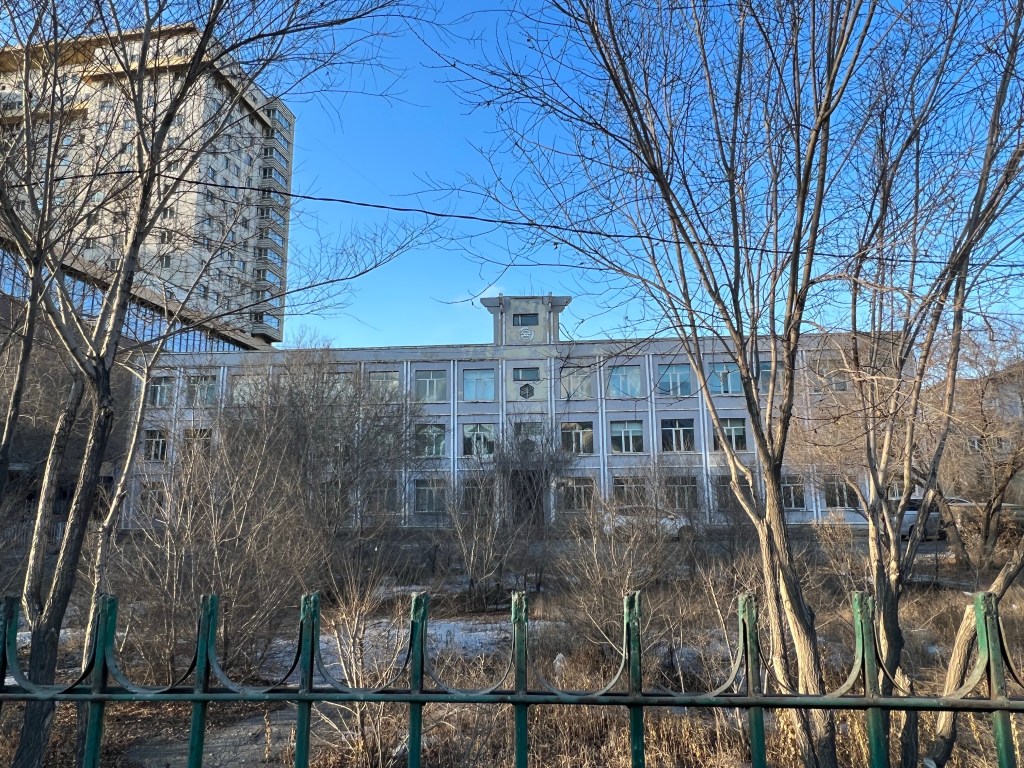
We arrived in Ulanbataar, Mongolia (abbreviated as UB from here on) in the afternoon on a Sunday. After collecting our luggage and exchanging money, we drove to our hotel in the city center. The cold we experienced outside of the airport and in the vans was hard to describe. Maybe we were just not used to this level of cold or we did not prepare enough clothes. But it was freezing..
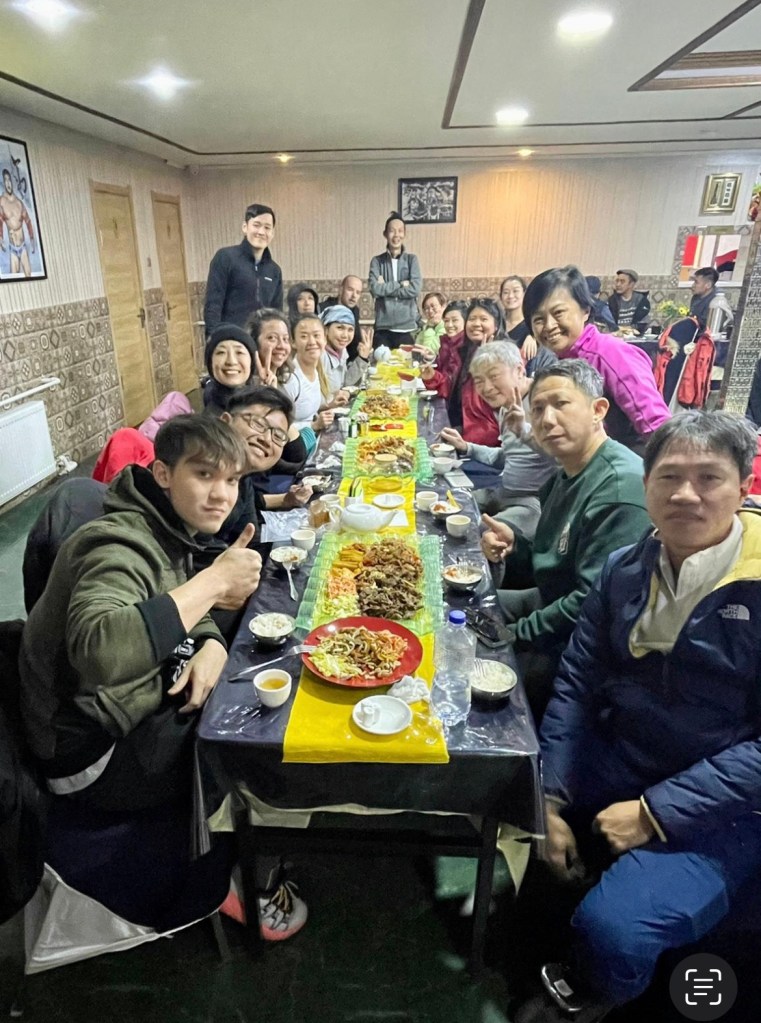
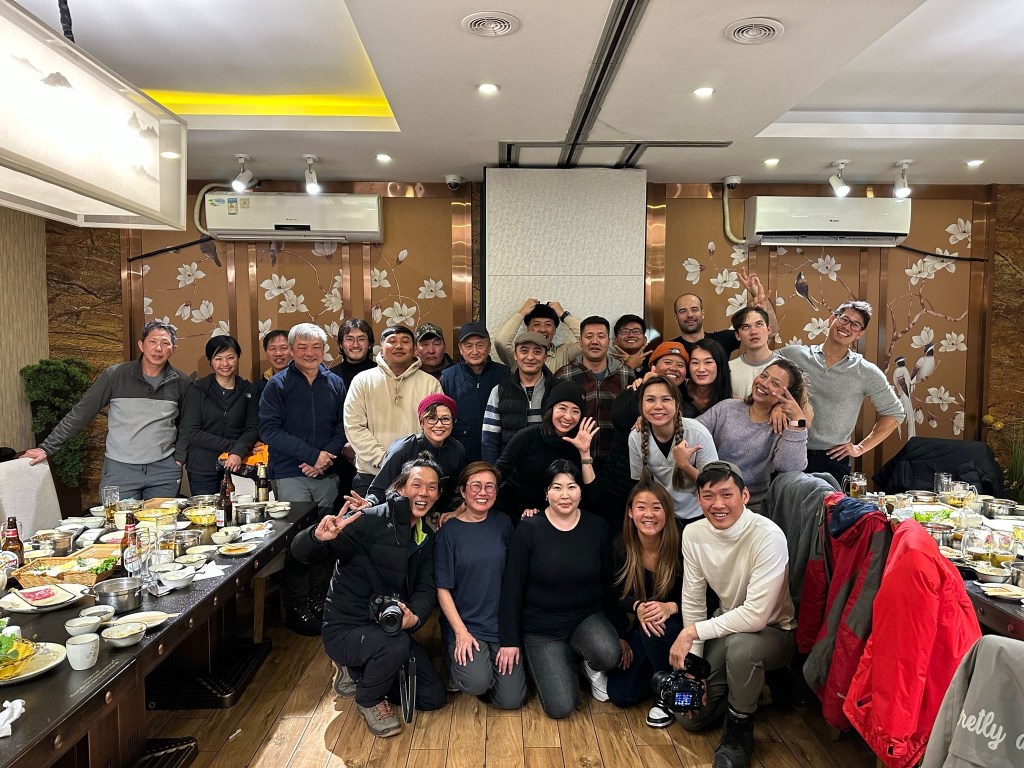
We celebrated our arrival with a team dinner, eating traditional Mongolian barbecue in a restaurant admonished with traditional Mongolian furniture and decorations. The next morning we set off for a 700 km journey towards the west of the country. The journey took ~12 hours, of which we followed off track, dirt roads for about 4.5 hours. We spent the night in a hotel in a small village. This stay was memorable for multiple reasons. It happened to be during Mongolian New Year and we got to witness some of the customs of celebrating this holiday. Due to the holiday, the extended families of the owners were visiting and we got to interact with many children dressed in traditional clothing. And finally, this was our last stop for a while where proper western shower and toilet facilities were available to us.

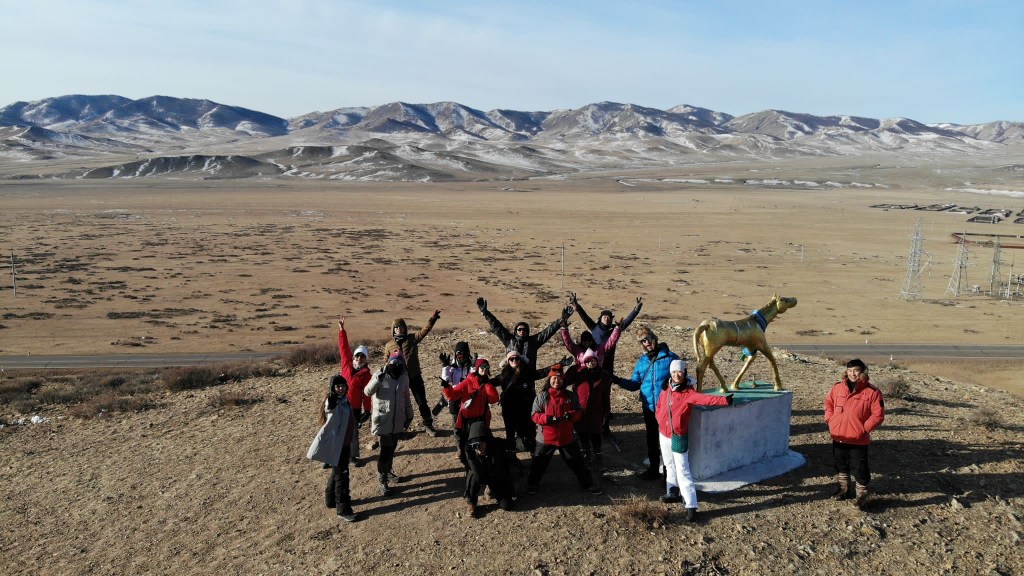
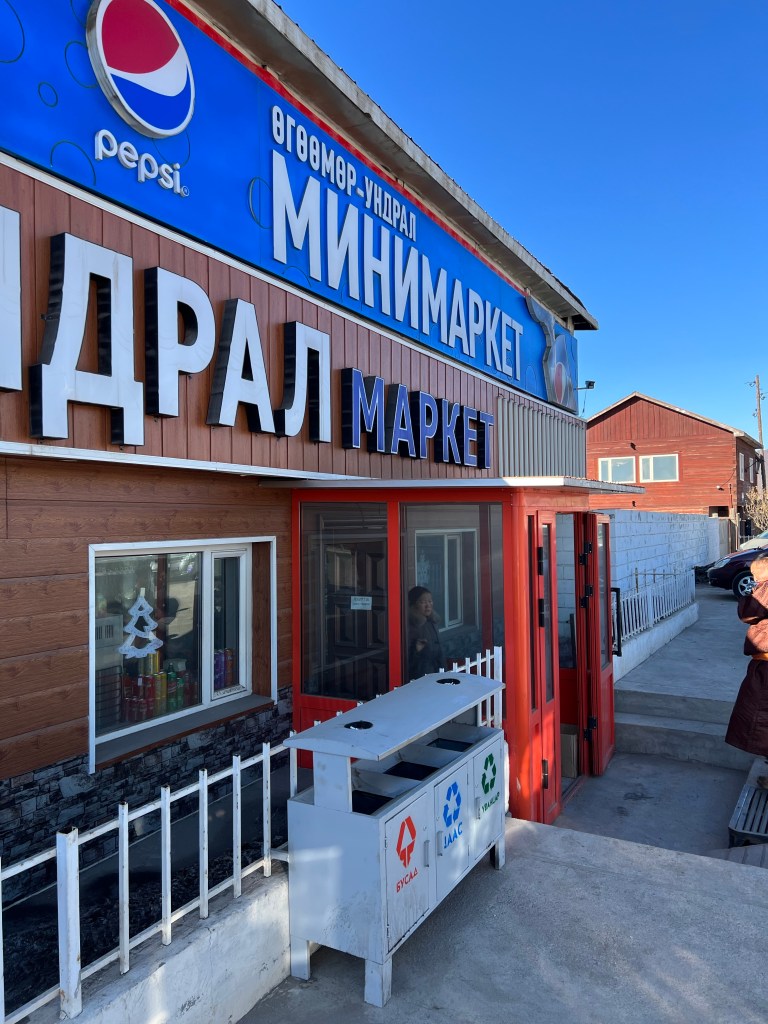
The next morning we set off for another 300 km+ drive to our final destination by the lake, Khatgal village. This time our journey followed paved roads, and we had an opportunity to stop at a regular grocery store one last time before going into the wilderness. This store was in Murun City, the closest city to Lake Khuvsgul.


In Khatgal village we stayed at a small guesthouse, where we had our first experience of sleeping in a Mongolian ger, a type of tent used by Mongolian nomads as their primary means of accommodation.


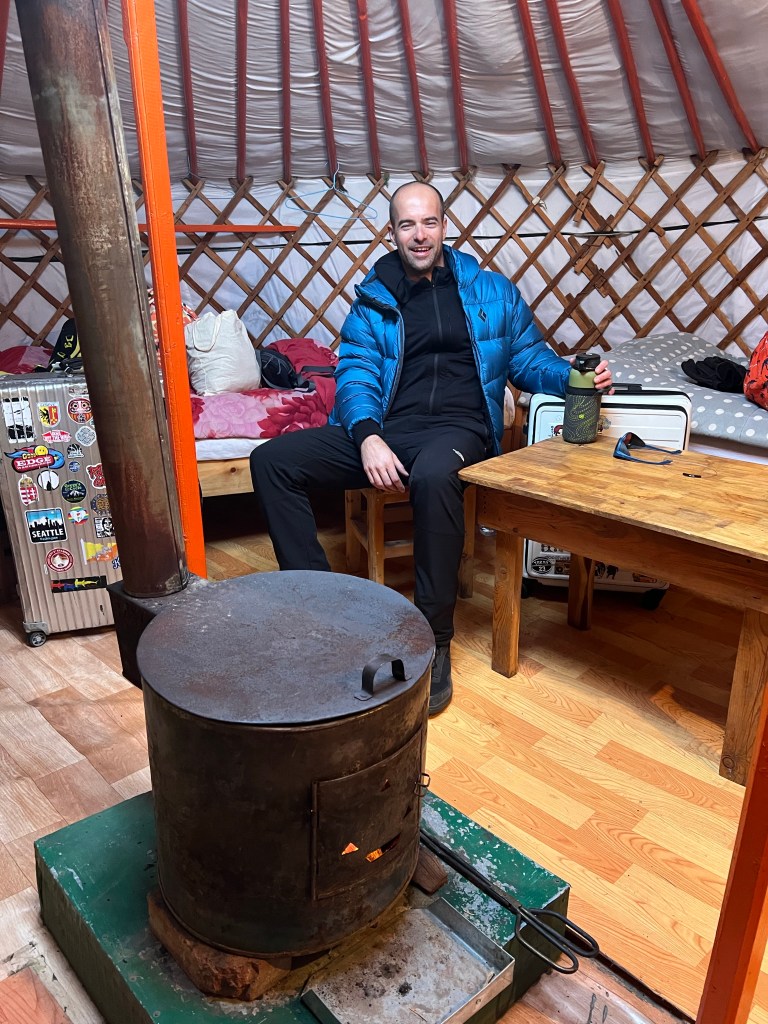
After a special night of sleep in gers under beautifully vibrant stars our trek across the lake began. For the next 3 days we were to stay in tents set up either on the lake ice or on the shore next to the lake. More on these experiences in the following chapter on our trek and lake life itself.

Upon completing our trek, we returned to the guest house in Khatgal village for 2 nights of rest and recreation before resuming our journey east to Ulanbataar and eventually back home to Singapore.
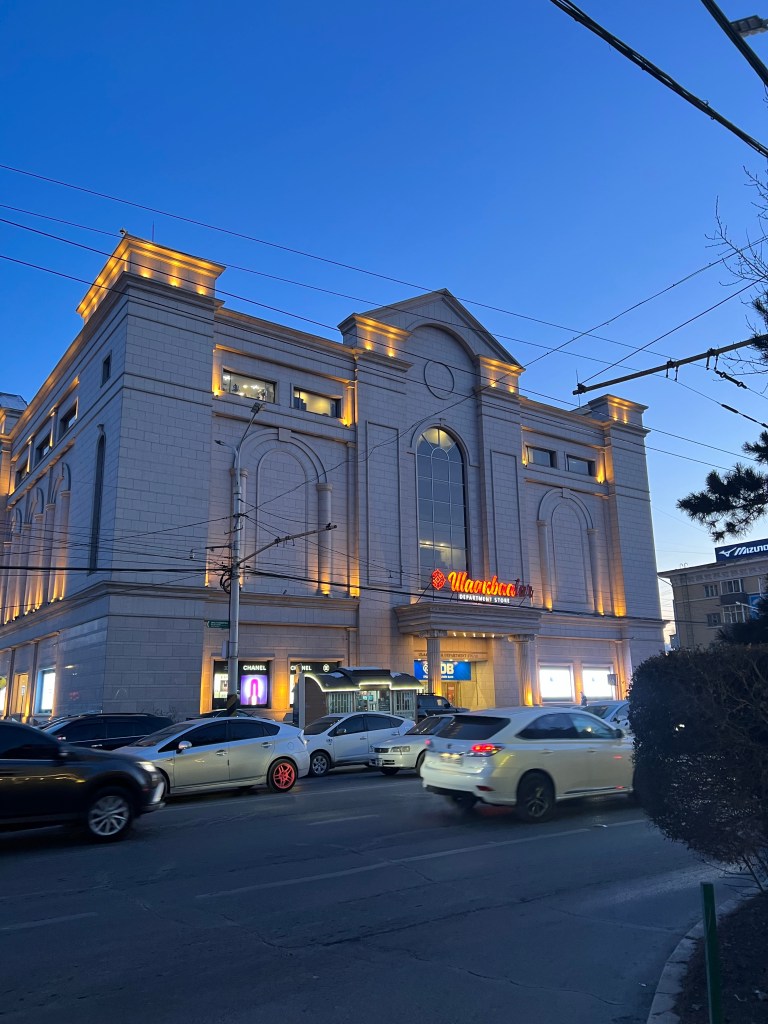
The car journey back, just like any return journey after completing a once in a lifetime adventure was not as exciting and generally went by uneventful. We stayed one night in a roadside log cabin and finally arrived in Ulanbataar mid afternoon on the next day, allowing us some time for shopping in the largest department store in Mongolia and for enjoying a hot pot dinner and celebratory drinks.

Author’s note on chapter 3:
I wrote this chapter on 6/3/2023, a Monday, our F5 Wellness Day. I was sitting in my regular Starbucks in Singapore’s Tanjong Pagar neighborhood, sipping my usual venti ice americano and watching the regular office crowd come and go.
4. On trekking and living on a frozen lake for 4 days
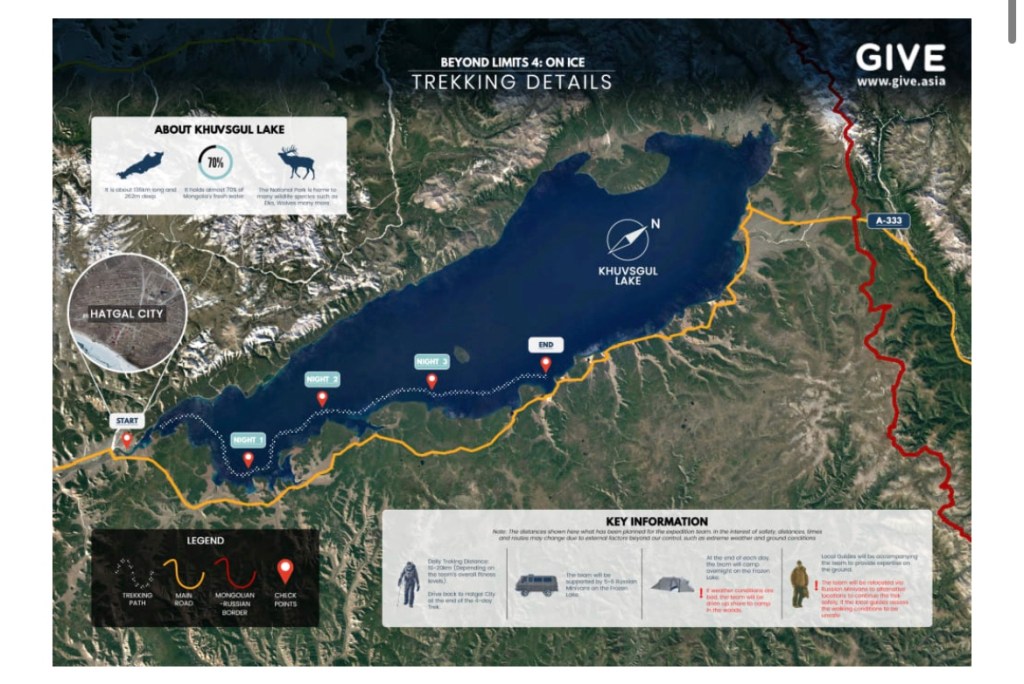
Lake Khuvsgul, the site of our trek and our home for 4 days, is one of the largest fresh water lakes in the world. It hosts ~2% of the fresh water our planet holds and as such is very precious not only for the locals but for entire race. It is located in northwestern Mongolia, on the border of the taiga region and in close proximity to Russia. It is nestled between rolling mountains and stretches ~130 km in a north/south direction. During winter months the temperatures can drop below -40 degrees Celsius, allowing the lake to develop an ice cover that is 1.5 meters thick on average, with some places growing to over 2 meters of ice cover, thus rendering the lake safe and convenient not only for pedestrian access but even for various vehicles to drive on it.
There are two villages where the population concentrates, one on the southern tip of the lake and another on the northern end. Other than these villages, most other inhabitants around the lake are nomads raising various livestock types during the suitable seasons of the year.
Our trek set out from Khatgal village on the southern end of the lake, with the goal to cover as much distance as possible in 4 days of hiking and 3 nights in tents.
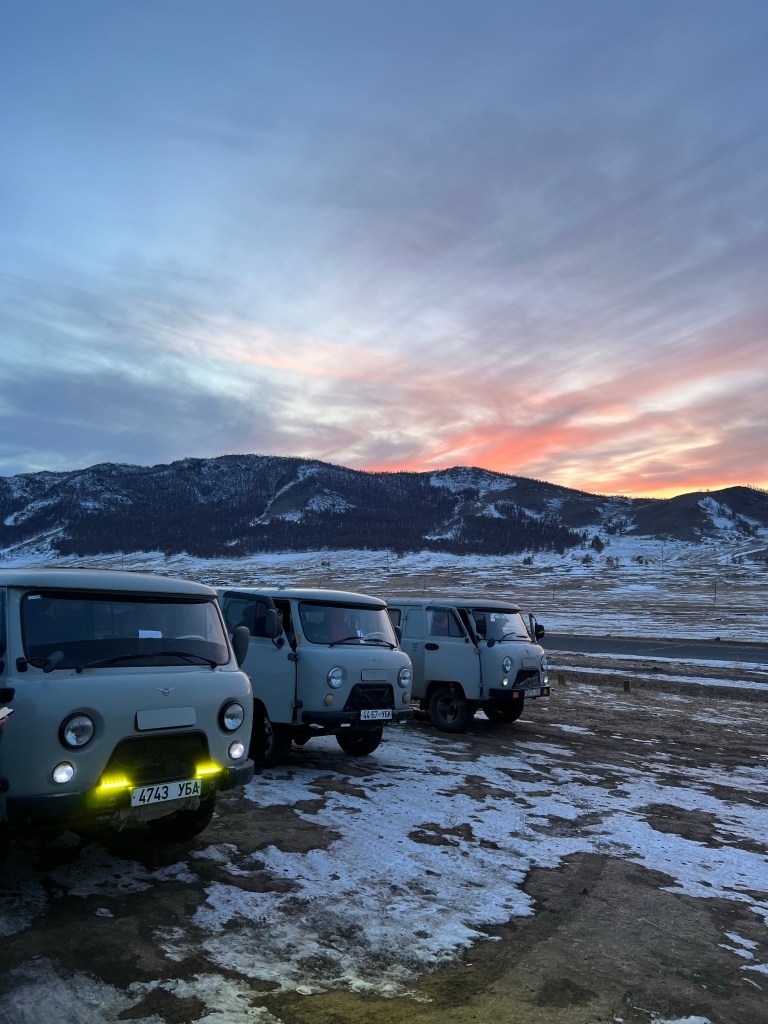
Our team consisted of 14 participants, 3 media crew, our organizer and leader from Beyond Expeditions, as well as 4 drivers, 3 guides and 2 cooks. To support the trip we had 4 UAZ brand vans follow us on the ice, 3 of those allocated to personnel and luggage transport, and the fourth vehicle dedicated to tent, equipment, kitchen tooling and food rations logistics.

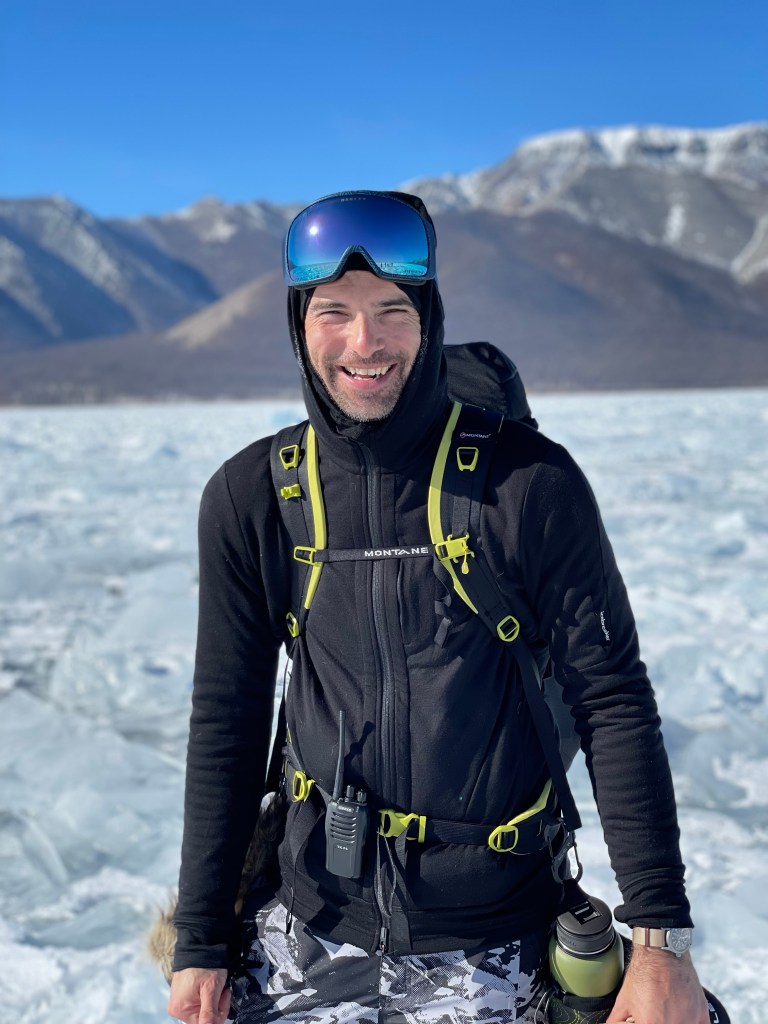
For easier logistics and safer trekking conditions, our leader split us into three smaller groups, with each group getting a team leader assigned. Those team leaders were issued walkie talkies to communicate with each other and the expedition leader to provide immediate access to whatever support was required for the participants’ best experience. These walkie talkies came in very handy during the entire trek and proved particularly sturdy from a battery life and ease of handling perspective. Some examples of our best use of these little machines was to call support vehicles when some team members needed a break from the trek in the relative safety of the vehicles, when we entered difficult to travers areas on the ice, requiring guidance on safe passage, when we saw interesting changes in terrain for which we felt an overhead drone video shot would give great perspectives to look back upon or , at times when the trek got a bit too monotone, to provide a means for some good old fashioned banter or reminiscing about a heated room or a hot shower.
Speaking of drones. We had a dedicated videographer with us on the trip. His equipment and skill of being able to get the maximum out of flight range, angles and finding the best scenes to film made for a lot of excitement among all of us every time we heard the familiar humming of the rotors and for a lot to look forward to once he finishes editing the videos from the entire trip. I recall with fond memories our experience traversing a particularly difficult section of the ice with many jagged and crammed up sheets of ice and how seeing the drone arrive above us to film our experience gave all of us a level of new found excitement and fortitude to tackle this section of the hike with vigor, energy and joy. Or the moment when we set off from a lunch break on the ice, walking in a single file for the first kilometer or so, having been joined by a stray dog who became a close friend to many expedition members and fitting into our video like a full fledgedmember of our expedition.
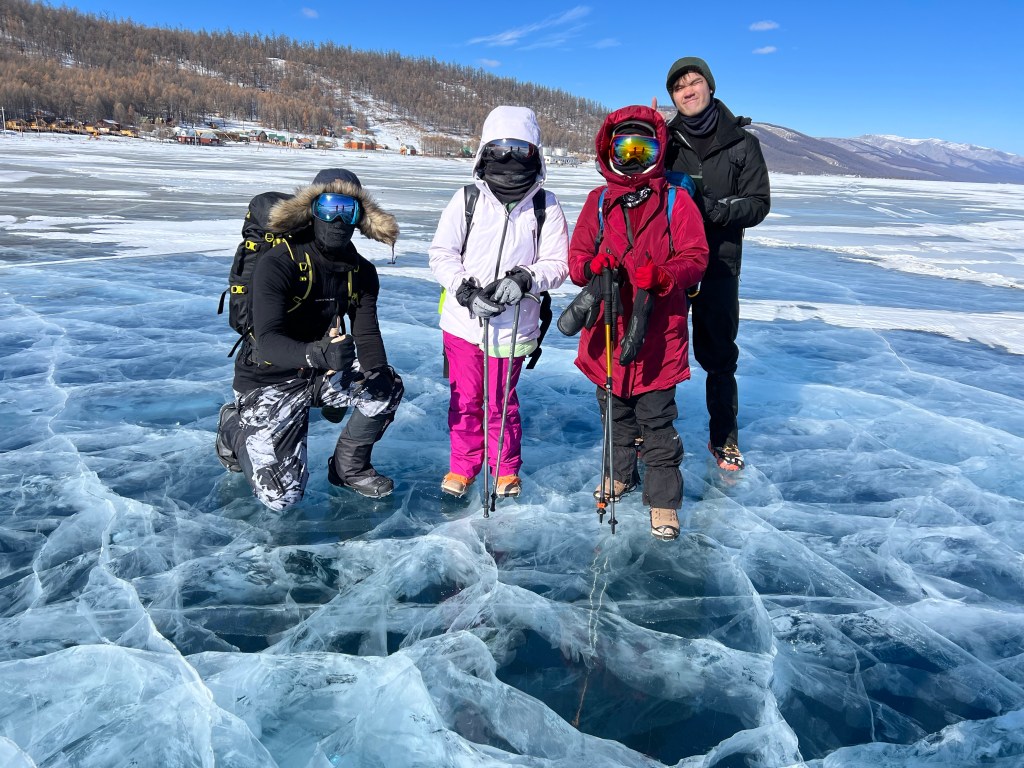
The conditions during the four days of our trek were as perfect as I would imagine they could be. We experienced temperatures between 0 and -10 degreesCelsius range, with bright sunshine and blue skies the entire time. Wind was negligible and as they days progressed from morning to afternoon, and our bodies warmed up from the hike, we could actually layerdown a bit. Caps and gloves had to stay on the entire time though, leaving one’s hand exposed for too long did indeed quickly bring forth numb fingers and initial onset of frost bites for some of us. Three of the most important accessories most of us relied on were sturdy and warm snow boots, ski goggles and thermos water bottles. Per the great preparation guidance by the organizer, we all applied ice trekking chains on our boots, to improve our walking traction. Some folks also augmented these with walking poles, which came in handy, especially at times when we had to cross uneven sections of the ice. As a result of the near-constant sunshine and the light reflection from the ice and snow cover in some areas, some form of eye protection was not only advisable, but almost a must. Most of us decided to wear ski goggles, which not only provided us the needed protection from the bright light but also additional coverage of the upper part of our face from the cold temperatures.
I would be remiss not to mention a piece of equipment I grew very fond of during the trip, my hot water bottle. Filling it up with hot tea in the morning and during the day has allowed me to carry a little piece of warmth with me, providing precious moments of respite, when I needed a pick-me-up at any part of the day. It was amazing to experience how well these bottles kept the water hot for many hours, even when my body started to feel more and more cold.
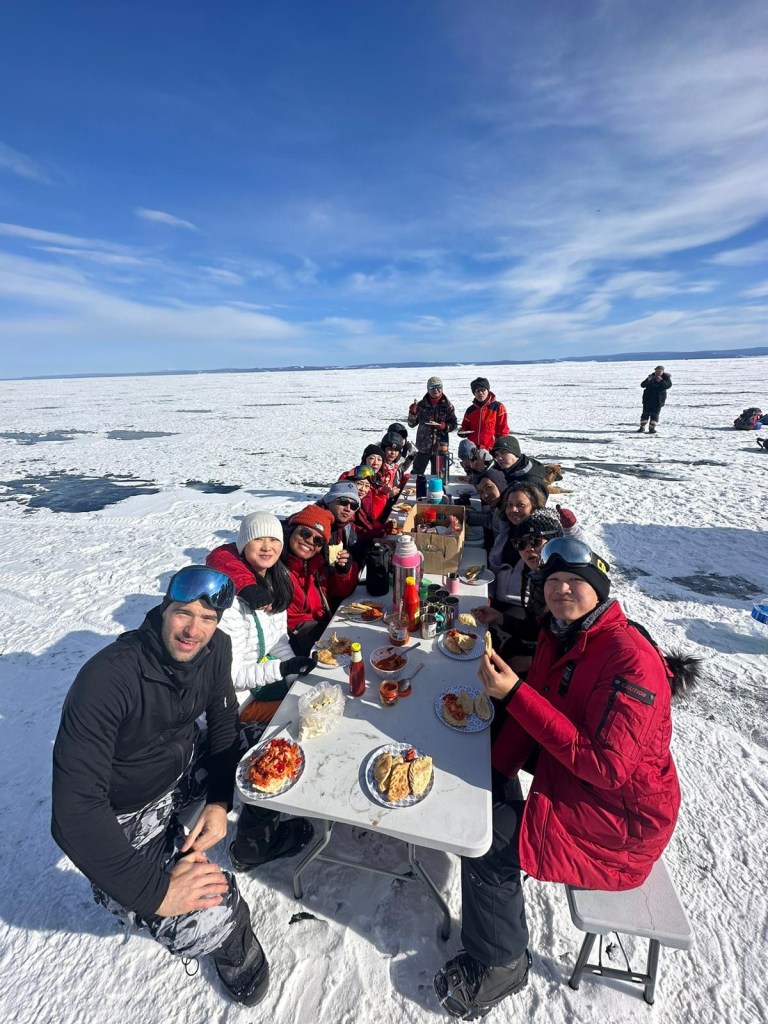
Each day started by us packing up our belongings, our sleeping bags, helping with breaking down our beds and tents and a hearty breakfast. Once we were all ready to go, we started off with a short warm up and stretching exercise, a few pictures of the location of our stay to add to our stash of wonderful memories and finally getting on the ice again. Our hike itself started around 10 am each morning, with the first leg ending with lunch around 2 pm. Lunch would be served to us on the ice on camp tables and benches. The supporting staff would stay behind in the mornings to cook our meal, than catch up with us in the vans along our trek. Their efficiency in cooking the meals, packing them up for us, serving them to us on the ice and packing up and cleaning up afterwards was really interesting to observe. Our meals consisted of rice or noodles, stir fried vegetables and some meat dishes on most days. For drinks we were served hot water, tea or coffee, to give us the best chance to stay warm and alert on the afternoon stretch of the hike. After our break, we would continue walking until about 4 pm or the point of our target distance for the day.


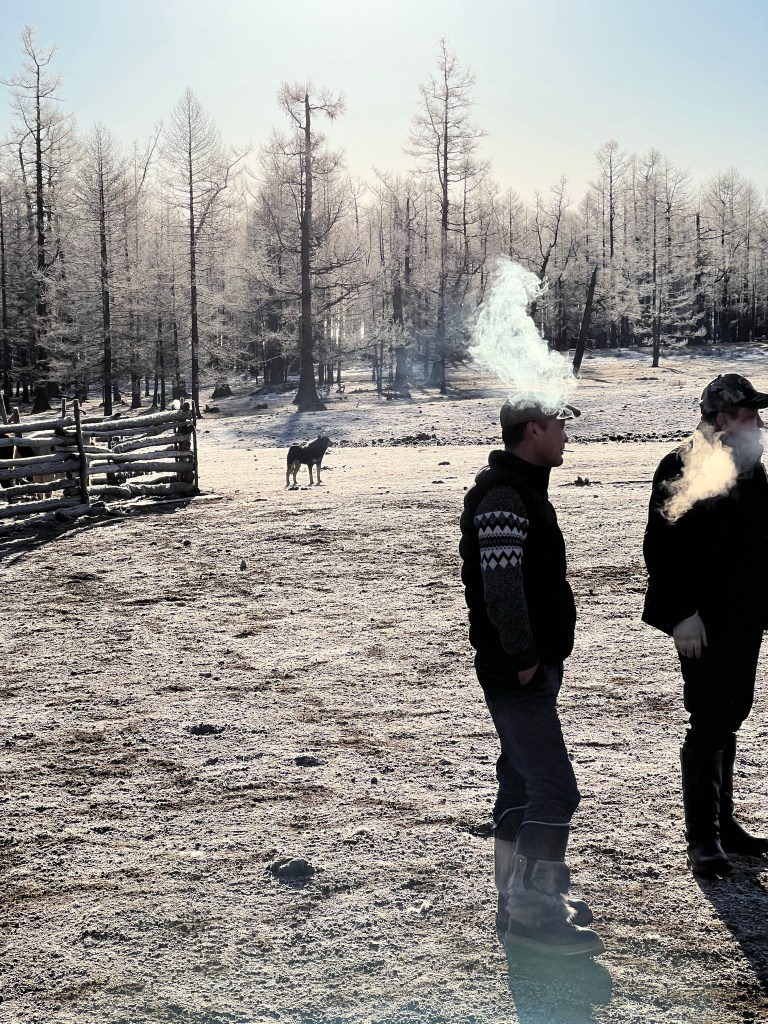
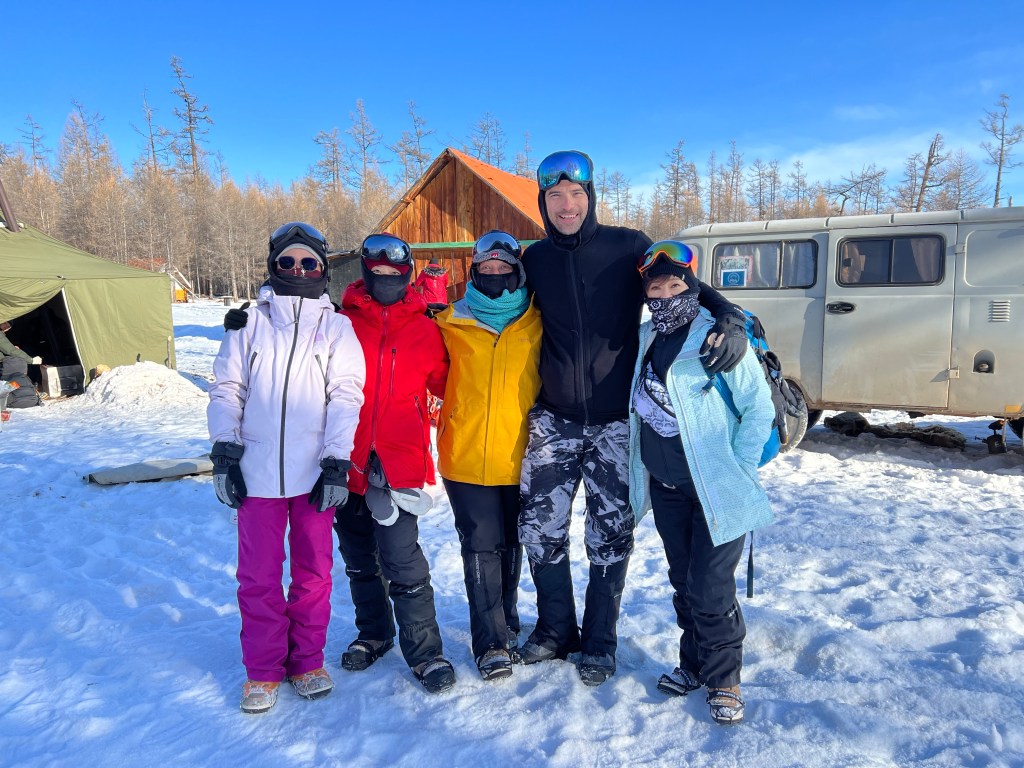

The end of the day’s effort would either be us arriving at the new camp site or getting picked up by our vans and driven to our resting location. Here the daily chores of setting up the tents, beds, kitchens would be repeated, with all of us also getting busy unpacking items we needed for the night, cleaning ourselves up, and on two of our three nights, collectively going out into the forests to collect wood for scorching bonfires we built. These provided an opportunity for us to bond over games, songs and sharing of anecdotes and stories. They also gave us a venue to share our experiences of the day and the trip and the hopes we have for the days ahead. For some reason I found it very special to look into the playful flames of a fire we built in the wild or to look up at the dark sky and sparkling stars keeping watch above us. These moments and the memories of the warmth the fires provided are some of the most memorable times I can think back to on this trip.


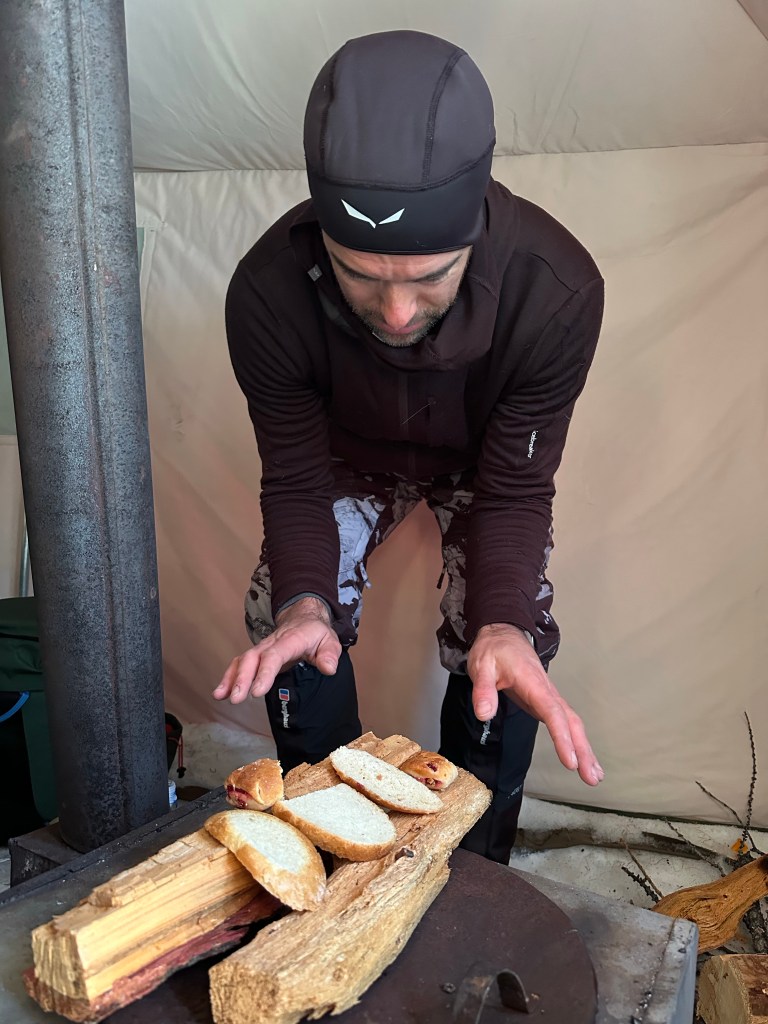
Spending three nights in tents brought many new learnings and experiences to all of us. Each of our tents held 7-10 people. Figuring out the sleeping arrangements in such confined setting was something we all had to get used to. Feeding the wood fire stove in our tents through hourly shifts amongst us is another thing most of us city dwellers never experienced before. I feel that these circumstances we had to adopt to allowed us to build special bonds and also get better and better at with each night passing by. In the second night we let the fire run out by about 4 am, which is the coldest time of the night. That night, the temperatures dropped to -35 degrees Celsius, and the shivering cold we all experience we had that night thought us to never make that mistake again. I also recall with vivid detail how we all positioned our frozen wet wipe bags and water bottles close enough to the fire to get them thawed but not too close to melt. Or the times we used the stovetop to toast bread or warm up a can of beans. Oh yes, sometimes a line of wet and cold socks or feet would also appear neatly arranged in the warmest and toasties areas close to the fire to garner some warmth before getting on with the days. Access to fire was the only way for all of us to get some warmth during the trek. And yes, whilst we learned to feed the flames and use them for as many purposes as feasible, it is important to mention that we could only do so after the locals helped us bring in and chop firewood to have available the entire time. Their efficiency in completing the numerous tasks they had and helping out their peers with tasks they were assigned to was exemplary. They always seemed very cheerful, ready to go and available, ensuring that our experience was the best and our safety never compromised.
All in all, we spent three nights in tents. The first night was on the ice, very close to the shore. This night was memorable in the sense that most of us never slept in a tent pitched on a frozen lake, with snow as our “floor”. Given our presence on the lake, we also heard and felt in our body the tremors and sounds of the living like ice, constantly moving, constantly cracking under the immense pressure of sheer mass of frozen water present. Those moaning sounds will remain me ingrained in me for a long time for sure, not so much from fear, rather the realization of the might and dynamism of nature. The second night, we set up our tents on the grounds of the lake ranger station, after 100 meters from the lake itself. Our final night held a truly Mongolian surprise for us. We were invited by a nomad family to set up our tents in the area of their home at the time, giving us a unique glimpse into the simple and efficient lives these folk live.


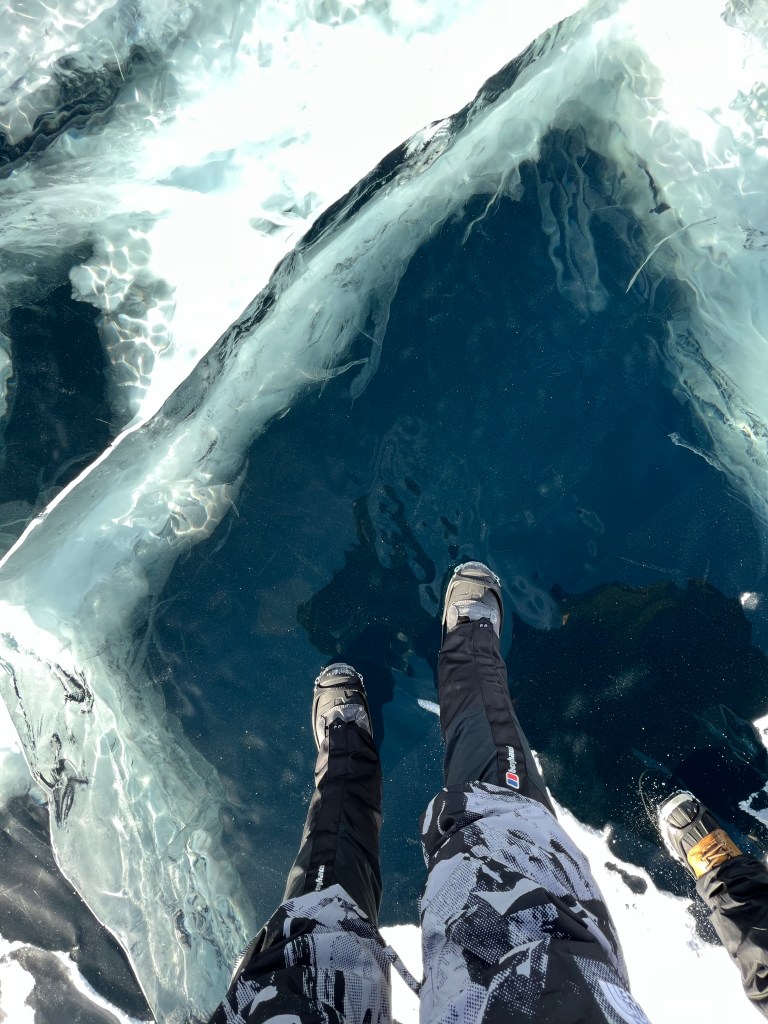
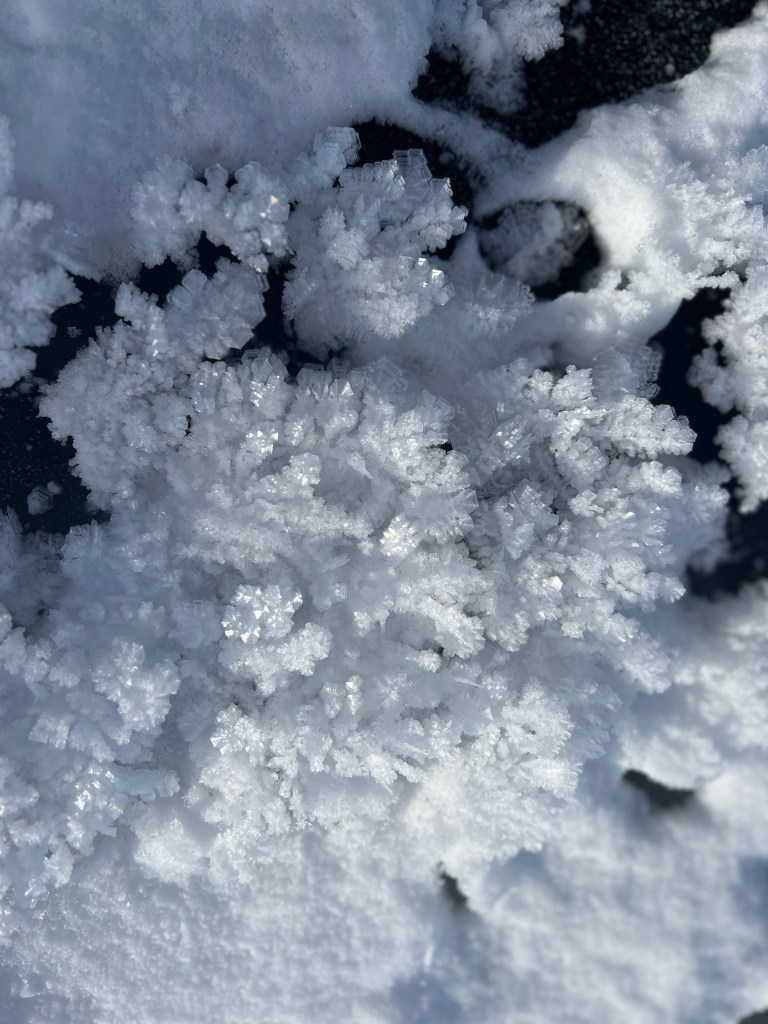
Thinking back on the passage of our time on the lake, a few things come to my mind. During our four days of trekking we covered just over 50 kilometers of distance. Amazingly each day held a surprise for us in terms of the types of terrain and ice we had to conquer. We saw deep blue and clear ice, we saw sections of deep blue and clear ice with beautiful white hairline cracks. We saw sections with white bubbles frozen into the ice, looking like blooms of little mushrooms. We saw entire sections of ice completely covered in snow. We traversed sections of the lake where the ice had cracked and refrozen, creating what seemed like rivers of ice within the frozen lake. We passed sections with lovely ice crystals that looks like blossoming flowers. And there were sections we faced where it was apparent to us that the ice is powerful, presenting us with car sized piled up ice sheets, jagged cracks of ice boulders the color of the bluest diamonds or the whitest of snows. It is magical to think about how a relatively small area like this lake can hold so many different terrains and beauty for our eye to behold.

I


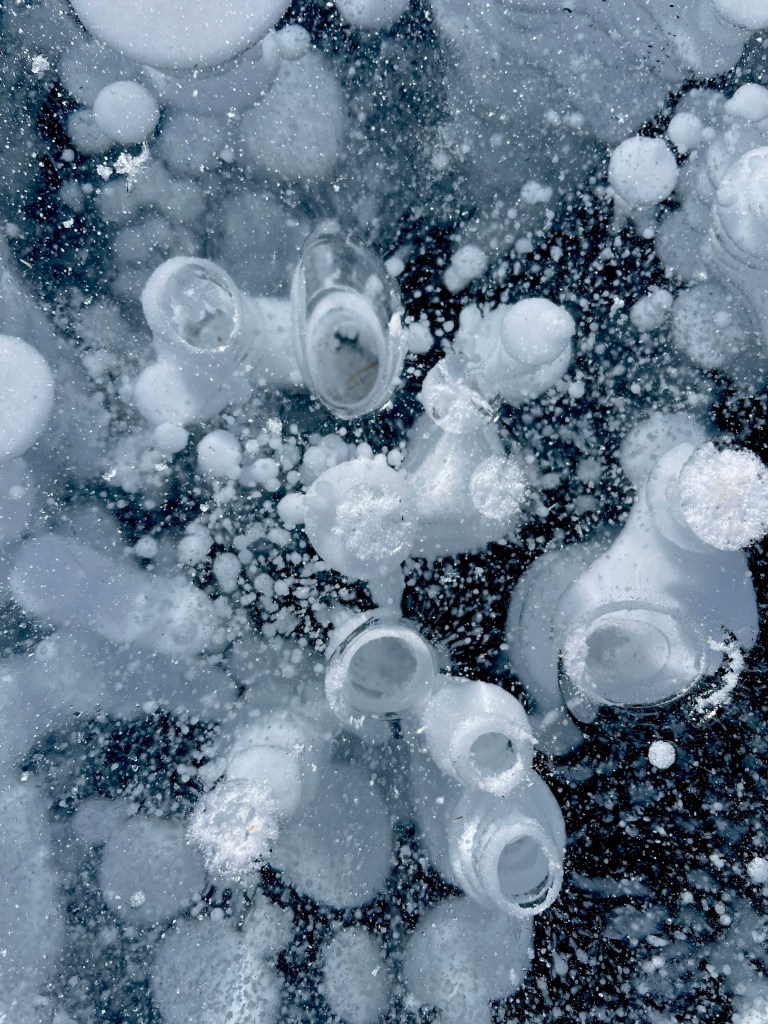

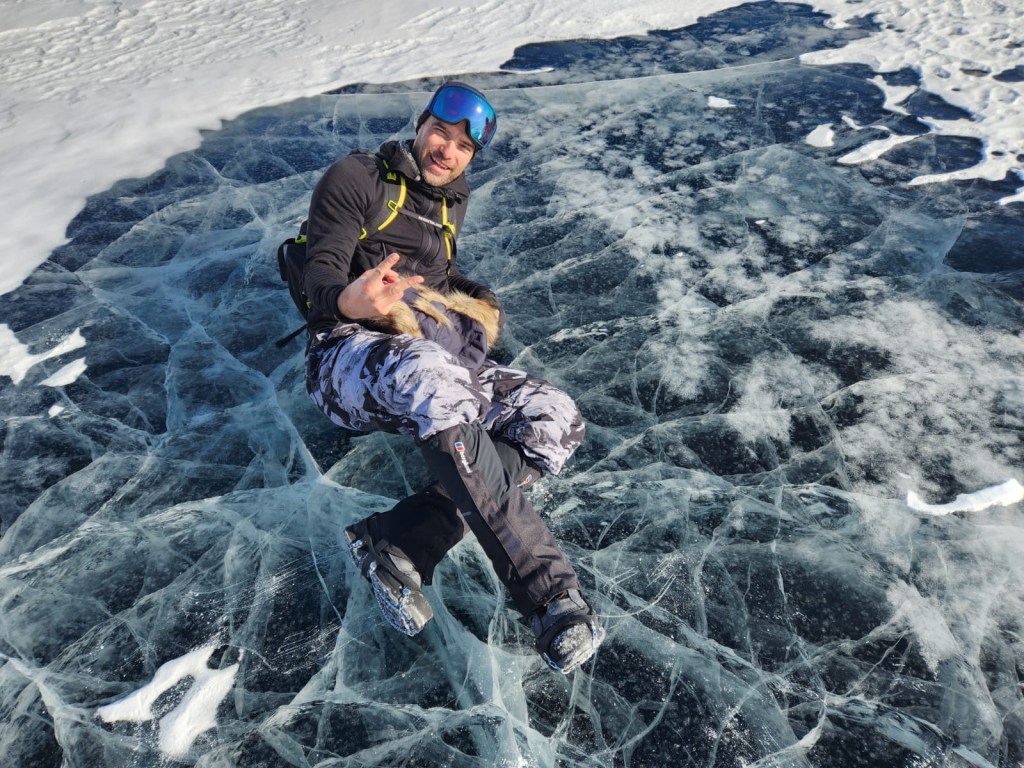
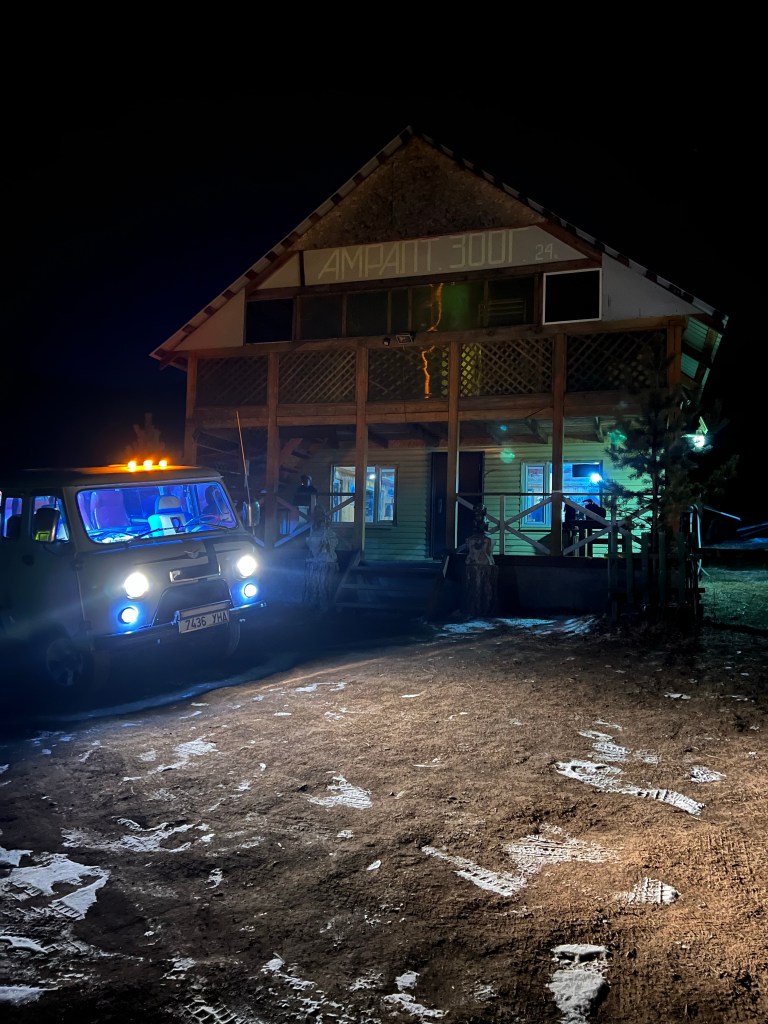
Besides trekking on ice, using our bodies and strength, we also got to experience travelling on the lake for long distances in our vans. Upon completion of our trek, we drove to the village on the northern tip of the lake, Khankh. This took us about 3 hours in the vans and got us to within 25 kilometers of the Russian border of Mongolia. This village is really small and due to the Mongolian New Year period, most places to visit were not available to us. As such, after a short stay on the shore, we got back in our vans and embarked on a more than 5 hour drive across the lake ice to get back to our base, the village on the southern tip, Khatgal. Oh, almost forgot to mention that this ride was completely in the dark, using only the knowledge, vision and sense of our guides and drivers and the headlights of our vans. Driving on ice was a new experience for me in general, but driving on ice in the dark took things to a whole different level. The ride felt safe, albeit uncomfortable due to the uneven surfaces we had to pass on the journey. The harsh conditions also forced the drivers to proceed slowly, having to make frequent stops, either to free a wheel that got stuck in a slippery section or to break large ice boulders blocking passage over frozen cracks in the ice. Despite these obstacles, the journey went by without problems and we arrived back in our guesthouse tired but elated, knowing we just conquered this beautiful but wild lake as a group.


Author’s note on chapter 4:
I wrote this chapter on 6/3/2023, a Monday, our F5 Wellness Day. I wrote majority of the content in a coffee shop in Singapore’s Chinatown neighborhood, sharing a table with my good friend Vivek, sipping an ice americano first, followed by an iced cold brew. In the breaks of my writing we would discuss politics, the stock market, our gym goals and dreams and debate which coffee shop we should try at the next available time we both are free.

I completed the chapter in a healthy food lunch place in Singapore’s Tanjong Pagar neighborhood which has long been on my list of places to try. I finished a nice vegan panini and drank some ice teaat table 5, which seemed to be the table number I got allocated multiple times on this day. Heck, the owner even named me Mr No 5 as I was settling my bill..☺️
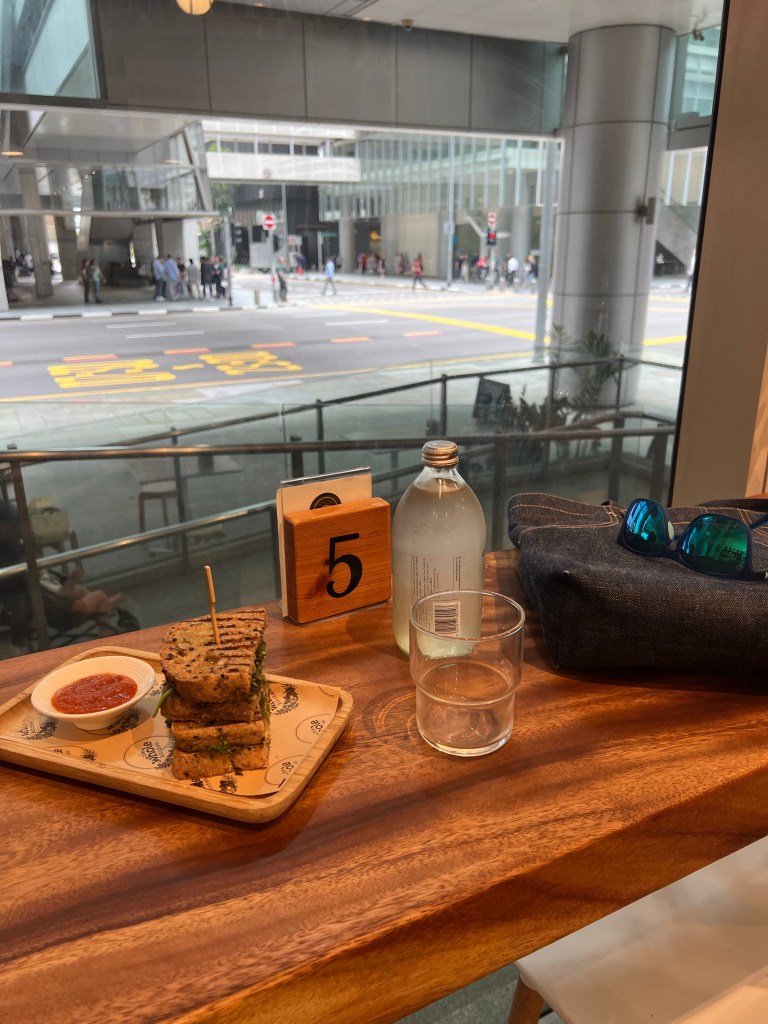
Stay tuned for subsequent parts of this diary to learn more about Mongolia the country, its people, its customs, my experience with food as a vegan in Mongolia, my account of memorable and funny moments, my experiences with the team and my reflections on fulfilling the purpose I set for myself for this trip.
 Andras’ personal page
Leave a comment